
Introduction
Embedded systems are everywhere from smartwatches and medical devices to automotive controllers and IoT sensors. While designing such systems, engineers do not just aim for functionality; they strive for optimal performance under strict constraints. Among the many performance parameters, three stand out as the most critical: latency, throughput, and power consumption. Understanding these concepts and more importantly, the trade-offs between them is essential for undergraduate students entering the field of embedded systems.
What is Embedded System Optimization?
Embedded system optimization is the process of improving system efficiency while working within limited resources such as memory, processing capability, and energy. Unlike general-purpose computing systems, embedded systems are designed for specific tasks, often in real-time environments.
A well-optimized system ensures:
- Fast response to inputs
- Efficient processing of tasks
- Minimal energy consumption
- Reliable and predictable behaviour
However, achieving all these simultaneously is rarely possible, leading to necessary trade-offs.
Key Performance Metrics in Embedded Systems
1) Latency: Measuring Responsiveness
- Latency refers to the time delay between an input and the corresponding output. It is a crucial parameter in systems where timing is critical.
- In practical terms, latency determines how quickly a system reacts. For example, in an automotive airbag system, the time between collision detection and airbag deployment must be extremely small.
- Lower latency improves responsiveness but often requires keeping the processor active and running at higher speeds.
2) Throughput: Measuring Processing Capacity
- Throughput defines the amount of work completed per unit time. It is especially important in systems that process continuous streams of data.
- For instance, a video processing embedded system must handle multiple frames per second. Higher throughput ensures smoother operation and better performance.
- Key characteristics of throughput:
a) Measured in ‘tasks/sec’ or ‘data/sec’.
b) Improved through parallelism and efficient algorithms.
c) Often requires higher computational power.
However, increasing throughput typically increases energy consumption.
3) Power Consumption: Measuring Energy Efficiency
- Power consumption refers to the amount of electrical energy used by the system. It is a critical factor in battery-operated devices such as wearable electronics and IoT nodes.
- Efficient power management ensures longer battery life and reduced heat generation.
- Common power optimization techniques include:
a)Using sleep and idle modes.
b)Reducing clock frequency.
c)Turning off unused peripherals.
d)Using interrupt-driven execution
- While reducing power is beneficial, it may negatively affect latency and throughput.
Interdependence of Latency, Throughput, and Power
These three metrics are deeply interconnected. Improving one often degrades another, creating a design challenge.
For example:
- Increasing processor speed reduces latency and improves throughput but increases power consumption. (Processor speed ↑, Latency ↓, Throughput ↑, Power consumption ↑).
- Reducing power by slowing the system increases latency and reduces throughput. (Power consumption ↓, Latency ↑, Throughput ↓).
- Increasing throughput using parallel processing increases power usage.
This relationship forces designers to carefully balance system requirements.
Trade-Off Analysis
1) Latency vs Power Consumption
Reducing latency typically requires keeping the processor active and operating at high speed. This leads to increased power consumption.
- Low latency systems: Always active, fast response, high energy usage
- Low power systems: Sleep modes, slower response, energy efficient
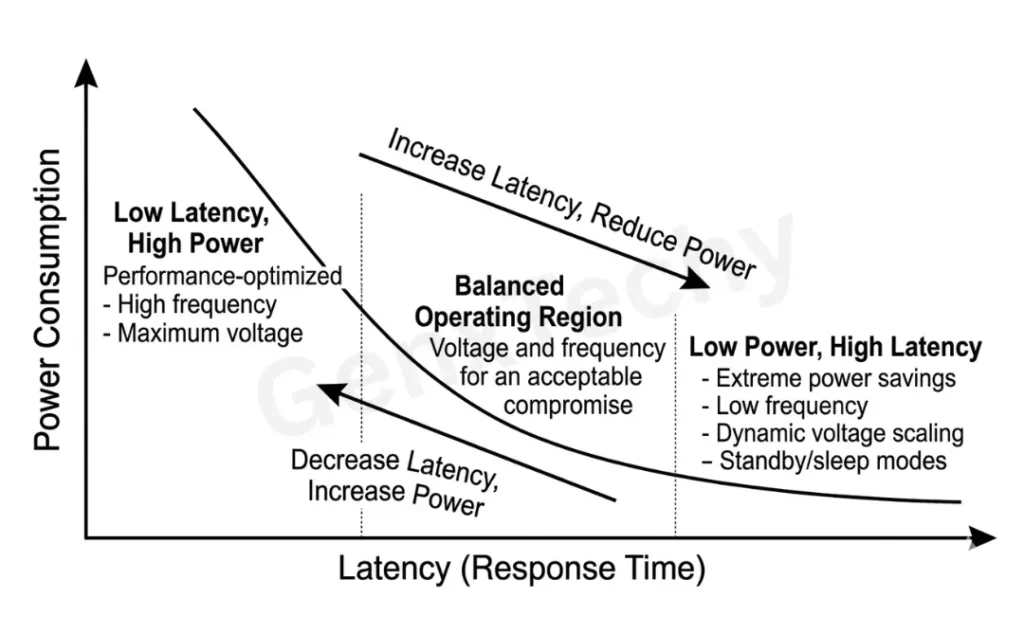
Fig. 1: Latency vs Power Consumption
- Example:
A medical monitoring system prioritizes latency to detect emergencies instantly, even if it consumes more power.
Table 1: Latency vs Power Consumption
| Parameter | Latency | Power Consumption |
|---|---|---|
| Definition | Time delay between input and system response | Amount of electrical energy used by the system |
| Primary Goal | Minimize response time | Minimize energy usage |
| Unit of Measurement | Seconds (ms, µs, ns) | Watts (W), milliwatts (mW) |
| Focus Area | Speed and responsiveness | Energy efficiency and battery life |
| System Behavior | Faster execution, immediate response | Reduced activity, energy-saving modes |
| CPU Operation | High clock speed, continuous operation | Low clock speed, sleep/idle modes |
| Impact of Optimization | Reducing latency increases system responsiveness | Reducing power increases battery life |
| Effect on other Parameter | Lower latency → higher power consumption | Lower power → higher latency |
| Typical Techniques | Interrupt handling, faster processors, real-time scheduling | Sleep modes, DVFS, peripheral shutdown |
| Application Examples | Airbag systems, industrial control, robotics | Wearables, IoT sensors, portable medical devices |
| Design Priority | Critical in real-time systems | Critical in battery-operated systems |
| Trade-Off Nature | Achieved at the cost of increased energy usage | Achieved at the cost of slower response |
2) Throughput vs Power Consumption
Increasing throughput often involves processing more data in less time, which requires more computational resources and energy.
- High throughput systems: Parallel processing, high clock speed, more power consumption.
- Low power systems: Reduced processing rate, lower the throughput.
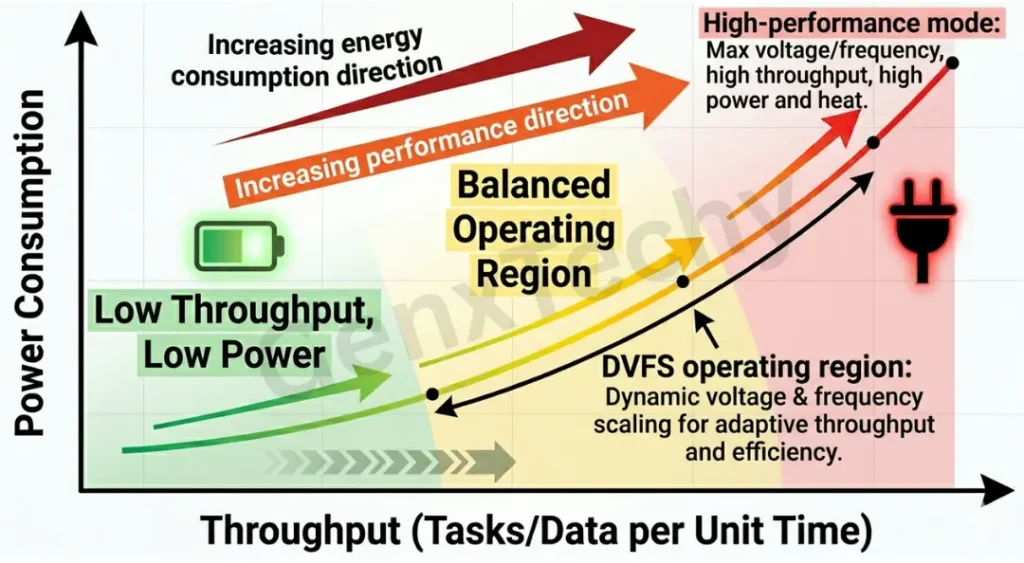
Fig. 2: Throughput vs Power Consumption
- Example:
A surveillance camera processing high-resolution video requires high throughput but consumes significant power.
Table 2: Throughput vs Power Consumption
| Parameter | Throughput | Power Consumption |
|---|---|---|
| Definition | Amount of data or number of tasks processed per unit time | Amount of electrical energy consumed by the system |
| Primary Goal | Maximize processing capacity | Minimize energy usage |
| Unit of Measurement | Tasks/sec, bits/sec, frames/sec | Watts (W), milliwatts (mW) |
| Focus Area | Performance and productivity | Energy efficiency and battery life |
| System Behavior | Continuous processing, high activity | Reduced activity, energy-saving modes |
| CPU Operation | High clock speed, parallel execution | Low clock speed, sleep/idle states |
| Impact of Optimization | Increasing throughput improves system performance | Reducing power extends system lifetime |
| Effect on Other Parameter | Higher throughput → higher power consumption | Lower power → reduced throughput |
| Typical Techniques | Parallel processing, DMA, pipelining, efficient algorithms | DVFS, sleep modes, peripheral shutdown |
| Application Examples | Video processing, networking devices, real-time analytics | Wearables, IoT sensors, portable embedded devices |
| Design Priority | Critical in data-intensive systems | Critical in battery-powered systems |
| Trade-Off Nature | Achieved at the cost of increased energy usage | Achieved at the cost of reduced processing capability |
3) Latency vs Throughput
Latency and throughput are two fundamental performance metrics in embedded systems. While both relate to system performance, they represent different aspects of timing and processing capability, and optimizing one does not necessarily improve the other. Optimizing for latency does not always maximize throughput.
- Low latency systems: Immediate response, less efficient batch processing.
- High throughput systems: Batch processing, delayed individual response.
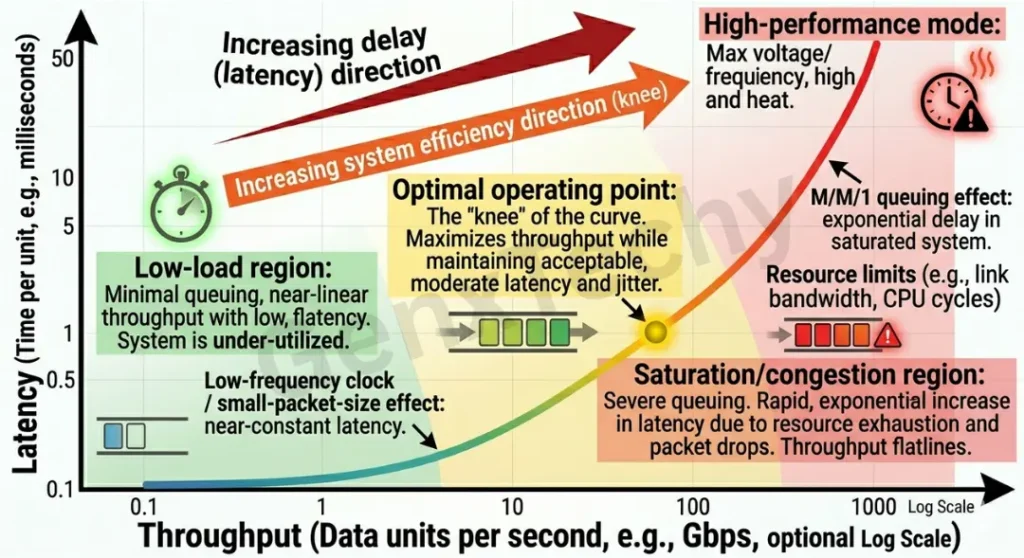
Fig. 3: Latency vs Throughput
- Example:
A data logging system processes data in batches, improving throughput but increasing latency for individual data points.
Table 3: Latency vs Throughput
| Parameter | Latency | Throughput |
|---|---|---|
| Definition | Time delay between input and system response | Amount of data or number of tasks processed per unit time |
| Primary Goal | Minimize response time | Maximize processing capacity |
| Unit of Measurement | Seconds (ms, µs, ns) | Tasks/sec, bits/sec, frames/sec |
| Focus Area | Responsiveness | Productivity and efficiency |
| System Behavior | Immediate handling of individual events | Continuous processing of multiple tasks |
| Processing Style | Event-driven, real-time execution | Batch processing or pipeline execution |
| Impact of Optimization | Reducing latency improves quick response | Increasing throughput improves total work done |
| Effect on Other Parameter | Lower latency may reduce throughput (less batching) | Higher throughput may increase latency (due to queuing/batching) |
| Typical Techniques | Interrupts, fast processors, real-time scheduling | Parallel processing, pipelining, buffering |
| Application Examples | Airbag systems, robotics control, industrial automation | Video streaming, data logging, network packet processing |
| Design Priority | Critical in real-time systems | Critical in data-intensive systems |
| Trade-Off Nature | Achieved by prioritizing immediate execution | Achieved by optimizing overall system efficiency |
Techniques to Balance Latency, Throughput, and Power
1. Dynamic Voltage and Frequency Scaling (DVFS)
Adjust CPU speed based on workload
High speed when needed, low otherwise
2. Interrupt-Driven Design
Avoid continuous polling
Reduces power while maintaining reasonable latency
3. Task Scheduling (RTOS)
Prioritize critical tasks
Balance responsiveness and workload
4. Hardware Acceleration
Use dedicated hardware (DSP, GPU, accelerators)
Improves throughput with lower energy per operation
5. Data Buffering
Batch non-critical tasks
Improves throughput without constant CPU usage