
Introduction
If you’ve ever wondered how your smartphone adjusts brightness automatically, how a smartwatch tracks your heart rate, or how a weather station measures temperature and humidity, “you’re already thinking about sensors”. These devices are the eyes and ears of modern electronic systems, enabling machines to perceive and respond to the physical world.
In embedded systems, sensors play a crucial role by converting real-world parameters like temperature, light, pressure, and motion into electrical signals that a system can understand. Without sensors, an embedded system would have no awareness of its surroundings and would be unable to make informed decisions.
In this article, we will explore sensors in a simple, intuitive, and practical way that is perfect for beginners stepping into the world of embedded systems.
What Are Sensors?
A sensor is a device that detects changes in the environment and converts them into electrical signals that a microcontroller can understand.
In simple terms:
A sensor is like the eyes, ears, and skin of an embedded system.
How Sensors Work
Sensors measure physical parameters such as:
- Temperature
- Light intensity
- Pressure
- Motion
- Humidity
They convert these physical values into electrical signals (analog or digital), which are then processed by a microcontroller.
Analog vs Digital Sensors
- Analog Sensors: Provide continuous output (e.g., voltage varies with temperature)
- Digital Sensors: Provide discrete output (e.g., ON/OFF or binary data)
| Feature | Analog Sensors | Digital Sensors |
|---|---|---|
| Output Type | Continuous voltage/current | Discrete (0 or 1) |
| Signal Nature | Smooth variation | Step-wise / binary |
| Accuracy | High (but noise-sensitive) | Stable (less noise) |
| Noise Sensitivity | High | Low |
| Processing | Needs ADC (Analog-to-Digital Converter) | Directly readable by microcontroller |
| Complexity | More complex interfacing | Easier to interface |
| Cost | Usually cheaper | Slightly costlier |
| Speed | Faster response | Depends on processing |
| Examples | Temperature sensor (LM35), Light sensor (LDR) | Ultrasonic sensor (HC-SR04), Digital temperature sensor (DS18B20) |
Common Types of Sensors
Figure 1 shows the different types of sensor used in various applications.
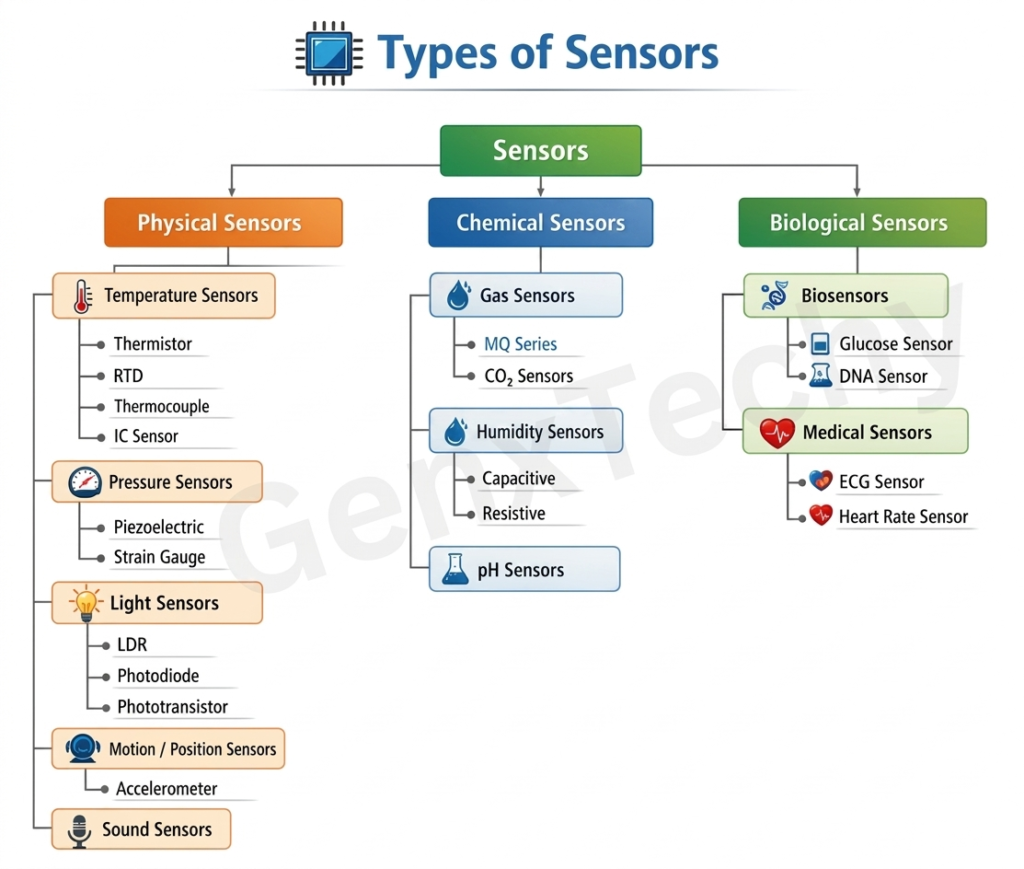
Fig. 1: Types of Sensors
In this article, temperature sensors are discussed comprehensively, including their types, working principles, and applications.
Temperature Sensors
A temperature sensor is a device that detects temperature and converts it into a measurable electrical quantity such as voltage, resistance, or digital data.
- Examples of Temperature sensors:
a) LM35 Temperature Sensor IC
b) TMP36 Temperature Sensor
c) DS18B20 Digital Temperature Sensor
d) DHT11 Temperature and Humidity Sensor
Types of Temperature Sensors
a) Thermistor (NTC/PTC)
A thermistor is a type of resistor whose resistance changes significantly with temperature. It is widely used for temperature sensing, control, and protection circuits.
- Types of Thermistors:
(i) NTC Thermistor (Negative Temperature Coefficient)
- Resistance decreases as temperature increases
- Highly sensitive to small temperature changes
(ii) PTC Thermistor (Positive Temperature Coefficient)
- Resistance increases as temperature increases
- Often used for protection
- Working Principle:
Thermistors work based on the temperature dependence of semiconductor materials made from metal oxides (like manganese, nickel, cobalt). As temperature changes, the charge carrier concentration changes. This causes a change in resistance.
Mathematical Relation:
R(T) = R0 eβ(1/T – 1/T0)
Here,
- R(T) = resistance at temperature T
- R0 = resistance at temperature T0
- β = material constant
- T = temperature in Kelvin
- Applications:
(i) Temperature Measurement (Digital thermometers, HVAC systems)
(ii) Temperature Control (Battery packs, Industrial systems)
(iii) Protection Circuits (Overcurrent protection (PTC), Inrush current limiting (NTC))
(iv) Consumer Electronics (Mobile phones, Laptops, Power supplies)
b) RTD (Resistance Temperature Detector)
An RTD (Resistance Temperature Detector) is a temperature sensor whose resistance changes predictably with temperature, typically using pure metals like platinum, nickel, or copper. RTDs are known for their high accuracy, stability, and repeatability.
- Types of RTD:
(i) Based on Material
- Platinum RTD (Pt100, Pt1000)
Most common due to excellent accuracy and stability - Nickel RTD
Lower cost but less stable - Copper RTD
Good linearity but limited temperature range
(ii) Based on Construction
- Wire-wound RTD
- Metal wire wound on a ceramic core
- High accuracy, used in precision applications
- Thin-film RTD
- Metal film deposited on substrate
- Faster response, compact size
(iii) Based on Lead Configuration
- 2-wire RTD → Simple but less accurate (lead resistance error)
- 3-wire RTD → Compensates lead resistance (industrial standard)
- 4-wire RTD → Highest accuracy (eliminates lead resistance effect)
- Working Principle:
RTDs operate based on the principle that electrical resistance of metals increases with temperature. As temperature rises, atomic vibrations increase. This causes more electron scattering result in increase in resistance.Mathematical Relation:RT=R0(1+αT)
Here,
- RT = resistance at temperature T
- R0 = resistance at reference temperature (usually 0°C)
- α = temperature coefficient of resistance
- T = temperature in °C
- Applications:
(i) Industrial Process Control (Chemical plants, Oil & gas industries)
(ii) Laboratory Measurements (High-precision temperature monitoring)
(iii) HVAC Systems (Air conditioning and refrigeration)
(iv) Power Plants (Boiler and turbine temperature monitoring)
(v) Automotive Industry (Engine temperature sensing)
c) Thermocouple
A thermocouple is a temperature sensor made by joining two dissimilar metals, which generates a voltage (EMF) when there is a temperature difference between the junctions. It is widely used for wide-range temperature measurement and harsh environments.
- Types of Thermocouples:
Thermocouples are classified based on the metal combinations used:
(i) Type K (Chromel–Alumel)
- Most widely used
- Temperature range: –200°C to 1260°C
- Good accuracy and durability
(ii) Type J (Iron–Constantan)
- Range: –40°C to 750°C
- Low cost but oxidizes at high temperature
(iii) Type T (Copper–Constantan)
- Range: –200°C to 350°C
- Good for low-temperature applications
(iv) Type E (Chromel–Constantan)
- High output voltage
- Good for cryogenic use
(v) Type S, R, B (Platinum-based)
- Very high temperature applications (up to ~1700°C)
- Used in furnaces and laboratories
- Working Principle:
The working principle of a thermocouple is based on the Seebeck Effect, which states that when two dissimilar metal conductors are joined to form two junctions and these junctions are maintained at different temperatures, a thermoelectric voltage (EMF) is generated in the circuit.
- One junction, called the hot junction, is exposed to the temperature to be measured, while the other, known as the cold (reference) junction, is kept at a known temperature.
- The temperature difference between these two junctions causes charge carriers to diffuse, producing a measurable voltage proportional to the temperature difference. This voltage is then used to determine the unknown temperature.
Mathematical Relation:
E = α (Th − Tc)
Here,
- E = Generated EMF
- α = Seebeck coefficient
- Th = Hot junction temperature
- Tc = Cold junction temperature
- Applications:
(i) Industrial Furnaces (Steel plants, Glass manufacturing)
(ii) Power Plants (Boiler and turbine temperature monitoring)
(iii) Aerospace & Automotive (Engine exhaust temperature measurement)
(iv) Food Industry (Ovens and temperature control systems)
(v) Cryogenic Applications (Very low temperature measurements (Type T, E))
d) Semiconductor / IC Temperature Sensors
Semiconductor or IC temperature sensors are integrated circuits that measure temperature using the temperature-dependent electrical properties of semiconductor devices (mainly transistors and diodes) and provide an analog or digital output proportional to temperature.
- Types of Semiconductor / IC Temperature Sensors:
(i) Analog IC Temperature Sensors
- Provide continuous voltage/current output
- Output is directly proportional to temperature
- Examples: LM35, TMP36
(ii) Digital IC Temperature Sensors
- Provide digital output (I²C, SPI, 1-Wire)
- Built-in ADC and calibration
- Examples: DS18B20, DHT11
(iii) On-chip Temperature Sensors
- Integrated within microprocessors/ICs
- Used for thermal management
- Working Principle:
The working principle of semiconductor (IC) temperature sensors is based on the temperature dependence of the voltage across a PN junction in devices like diodes or transistors.
- As temperature increases, the forward voltage (VBE) of the junction decreases at a predictable rate (approximately −2 mV/°C) due to increased charge carrier activity.
- By measuring this voltage change often using two transistors operating at different current levels, the sensor generates a signal proportional to absolute temperature.
- This signal is then processed within the IC to produce either an analog output voltage or a digital temperature reading, making these sensors easy to interface with electronic systems.
Mathematical Relation:
VBE ≈ VT ln(Ic /Is)
Here,
- VBE = Base-emitter voltage of transistor
- VT = Thermal voltage
- IC = Collector current
- IS = Saturation current
- ln = Natural logarithm
- Applications:
(i) Consumer Electronics (Smartphones, laptops (CPU temperature monitoring))
(ii) Embedded Systems & IoT (Arduino, Raspberry Pi projects, Smart home systems)
(iii) Industrial Automation (Equipment temperature monitoring)
(iv) Medical Devices (Digital thermometers, Wearable health devices)
(v) Automotive Systems (Battery and engine temperature sensing)